Learn why CABG is used, how heart bypass surgery works, recovery milestones, risks, and questions to ask your cardiac care team before treatment options today.
TL;DR: Coronary artery bypass grafting uses blood-vessel grafts to restore blood flow beyond serious coronary blockages. It is often considered for significant left-main disease, complex multivessel disease, certain patients with diabetes or impaired heart pumping, and cases in which PCI is unsuitable or has not solved the problem. CABG is substantial surgery, so individual risks and recovery vary. The best decision comes from the full clinical context and, when appropriate, a Heart Team review. After surgery, cardiac rehabilitation, medication adherence, tobacco avoidance, lipid control, diabetes care, nutrition, and gradual physical activity remain central to protecting long-term heart health.
Blocked heart arteries can sound straightforward—find the blockage and fix it—but the decision is rarely that simple. Symptoms, diabetes, the number and location of narrowed arteries, heart pumping strength, and the feasibility of stents all matter. Coronary artery bypass surgery is a major operation designed to restore blood flow beyond severe coronary blockages. This guide answers the practical informational questions patients and families ask: why CABG is recommended, what happens in theatre, how recovery usually unfolds, and how to have a useful discussion with the Heart Team.
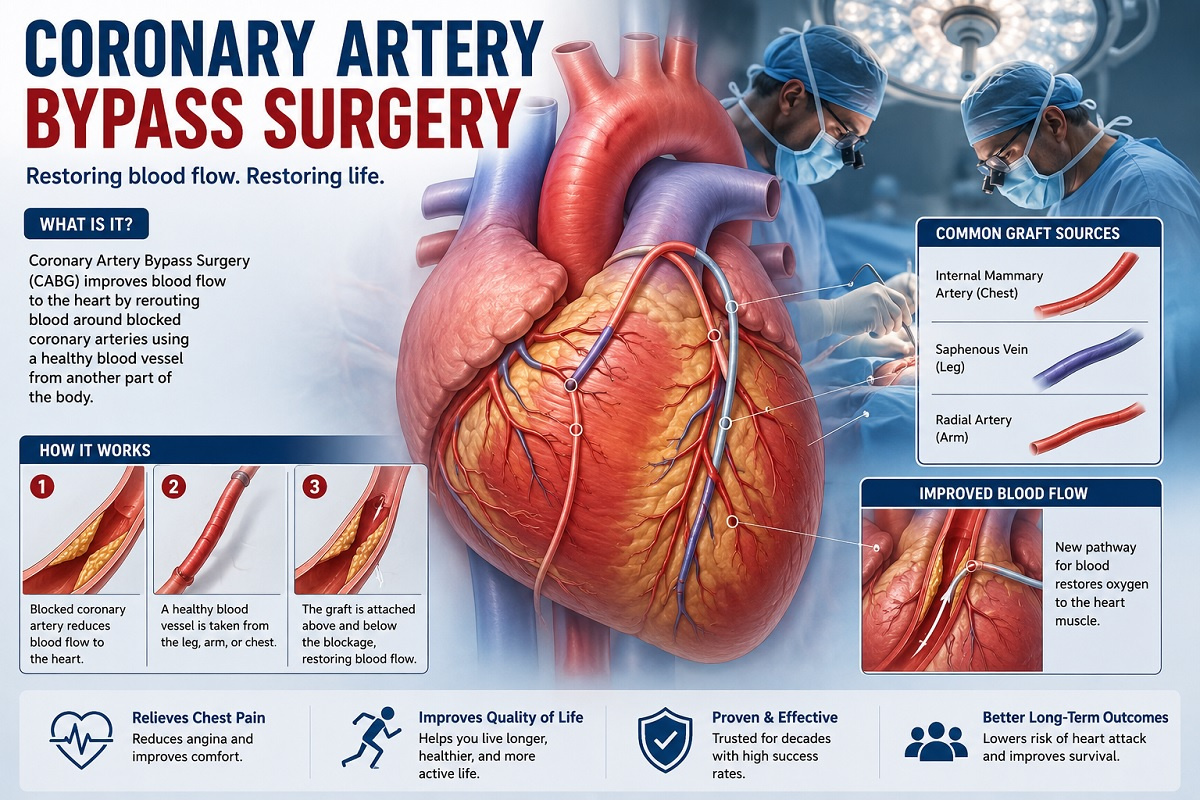
CABG surgery creates a new route for blood to reach heart muscle beyond a narrowed or blocked coronary artery. A surgeon attaches a healthy blood vessel—often from the chest, arm, or leg—to bypass the diseased segment. It may be recommended for complex multivessel coronary artery disease, significant left-main disease, or anatomy not well suited to stenting. It treats blood-flow problems; it does not remove the need for medicines and long-term risk-factor control.
Coronary artery bypass grafting (CABG), also called heart bypass surgery or coronary bypass surgery, is an operation in which a cardiac surgeon uses one or more blood vessels from elsewhere in the body to create alternate pathways around blocked coronary arteries. The goal is myocardial revascularization: improving blood supply to heart muscle affected by ischemia, relieving angina in appropriate patients, and reducing risk in selected high-risk coronary artery disease patterns.
Why might a bypass be recommended?
Coronary artery disease develops when atherosclerotic plaque narrows the vessels that supply oxygen-rich blood to the myocardium. A plaque can limit flow gradually, causing stable angina or breathlessness with exertion. If plaque ruptures and a clot forms, it can contribute to acute coronary syndrome or myocardial infarction.
A bypass is not selected simply because an angiogram shows a narrowing. The treatment plan usually considers the distribution and complexity of disease, whether symptoms persist despite guideline-directed medical therapy, ventricular function, kidney and lung health, diabetes, previous procedures, surgical risk, and patient preference. In complex cases, the cardiologist, interventional cardiologist, and cardiothoracic surgeon may review options as a Heart Team.
CABG may be discussed when there is:
- Significant left-main coronary artery disease
- Extensive multivessel disease, especially when anatomy is complex
- Diabetes with multivessel disease involving the left anterior descending artery
- Reduced left-ventricular ejection fraction with suitable coronary anatomy
- Persistent ischemia or angina when medicines and/or PCI are insufficient or unsuitable
- A failed or impractical percutaneous coronary intervention (PCI) in selected urgent situations
Why location and complexity matter
The left anterior descending (LAD) artery supplies a large area of the left ventricle. Disease affecting the left main artery, which branches toward the LAD and left circumflex artery, can therefore be particularly consequential. Angiography, fractional flow reserve or other physiological testing, stress imaging, and clinical symptoms help clinicians decide whether a lesion is causing meaningful ischemia.
Summary: A bypass is a revascularization strategy, not a default response to every blockage. The best option depends on the whole clinical picture—not a single test result.
How does CABG surgery work?
The grafts create detours
The surgeon connects a conduit above and below the blockage so blood can reach the coronary artery beyond it. Common graft choices include the internal mammary artery from the chest wall, the radial artery from the forearm, and the saphenous vein from the leg. The choice depends on the target artery, vessel quality, circulation in the donor site, prior procedures, age, and surgical plan.
A person may hear “double,” “triple,” or “quadruple bypass.” These descriptions refer to the number of coronary vessels or territories bypassed; they do not, by themselves, measure danger or predict an individual outcome.
What happens on the day?
Exact protocols differ by hospital and patient, but a conventional CABG pathway commonly includes:
- General anesthesia, a breathing tube, IV access, monitoring lines, and a urinary catheter.
- Harvesting one or more graft vessels.
- Accessing the heart, often through a median sternotomy, where the breastbone is divided.
- Connecting grafts using either an on-pump approach with cardiopulmonary bypass or a carefully selected off-pump technique.
- Restarting and assessing heart function when applicable, then closing the sternum and skin incision.
- Transfer to intensive care for close monitoring before step-down recovery.
Are minimally invasive and hybrid options available?
Some centres offer minimally invasive direct coronary artery bypass, robot-assisted approaches, or hybrid revascularization that combines surgery with PCI. These methods may avoid a full sternotomy in selected patients, but they are not interchangeable with conventional surgery. Eligibility depends on which vessels are diseased, their accessibility, prior chest surgery, overall anatomy, and the local team’s expertise. A smaller incision is not automatically the safer or better operation.
Preoperative assessment
Before surgery, clinicians often use blood tests, electrocardiogram (ECG), echocardiogram, coronary angiography or CT angiography, chest imaging, kidney-function testing, and sometimes carotid or peripheral vascular assessment. Patients should give a complete medication and supplement list. Antiplatelet agents, anticoagulants, diabetes medicines, and herbal products may need a clinician-directed plan; never stop them independently.
Summary: CABG reroutes blood with grafts. It does not “scrape out” plaque and it does not cure atherosclerosis throughout the body.
CABG versus stents and medicines
PCI uses a balloon and usually a stent delivered through a catheter to open a coronary narrowing. CABG uses grafts to route blood around blockages. Optimal medical therapy includes lifestyle treatment and medicines such as antiplatelet therapy, lipid-lowering treatment, blood-pressure therapy, antianginal treatment, and diabetes management when indicated.
| Consideration | CABG | PCI with stent | Medical therapy alone |
|---|---|---|---|
| Method | Surgical grafts bypass disease | Catheter opens a target lesion | Reduces risk and symptoms without a procedure |
| Typical role | Complex anatomy or selected high-risk disease | Suitable focal or less-complex lesions | Essential for nearly all CAD patients; may be primary strategy in some cases |
| Recovery | Longer, especially after sternotomy | Usually shorter | No procedural recovery |
| Up-front burden | Major surgery and hospital recovery | Invasive catheter procedure | Medication effects and ongoing monitoring |
| Decision driver | Anatomy, diabetes, ventricular function, surgical risk | Anatomy, urgency, bleeding risk, ability to take antiplatelets | Symptoms, ischemia, anatomy, preferences, overall risk |
This is a decision table, not a treatment rule. For example, two people with “three blocked arteries” can reasonably receive different recommendations because their lesion complexity, symptoms, ejection fraction, frailty, diabetes status, and capacity for dual antiplatelet therapy differ.
Benefits and trade-offs
Potential benefits of CABG include improved blood flow and symptom control, and in selected disease patterns a survival benefit compared with medical therapy. The principal trade-off is that it is major surgery, with a larger immediate recovery burden than PCI. Revascularization also complements—not replaces—secondary prevention.
Summary: “Stent versus bypass” is not a consumer product comparison. It is a personalised risk-and-benefit decision made from coronary anatomy and clinical context.
Risks and recovery
What risks should be discussed?
Every operation has risks. CABG-specific discussions commonly include bleeding or transfusion, infection including sternal wound infection, irregular heartbeat such as atrial fibrillation, stroke, heart attack, kidney injury, delirium or cognitive changes, breathing complications, blood clots, graft failure, and death. Risk varies substantially according to age, urgency, heart function, diabetes, smoking, kidney disease, lung disease, prior stroke, frailty, and whether surgery is a first or repeat operation.
Ask the surgeon for a personal—not generic—risk estimate and whether a validated risk model is being used. Seek urgent clinical attention for chest pressure, severe shortness of breath, fainting, or symptoms of a possible stroke; do not wait for a routine appointment.
Typical recovery milestones
Hospital length of stay and recovery pace vary. Immediately after surgery, the care team focuses on breathing support, pain control, rhythm monitoring, mobility, wound care, fluid balance, and prevention of complications. At home, fatigue, altered sleep, mood changes, reduced appetite, and gradual improvement in stamina are common themes. A sternotomy needs time to heal, so activity and lifting advice must come from the surgical team.
Cardiac rehabilitation is one of the most useful next steps. It combines supervised exercise, education, nutrition support, medication review, and psychological support. It also helps patients rebuild confidence without mistaking normal post-operative fatigue for a reason to remain inactive.
Best practices after discharge
- Take every prescribed medicine as directed and ask before adding over-the-counter drugs or supplements.
- Attend surgical, cardiology, and cardiac-rehabilitation follow-up appointments.
- Follow the wound-care instructions precisely and report fever, increasing redness, drainage, separation, or worsening pain.
- Progress walking and activity to the agreed plan rather than chasing a universal timeline.
- Avoid tobacco and work with the care team on LDL cholesterol, blood pressure, glucose, sleep, diet, and physical activity.
People Also Ask
How long does heart bypass surgery take?
A conventional operation often lasts several hours, but procedure time is only one part of the day. Preparation, anesthesia, transfer, and early intensive-care monitoring add substantial time. The number of grafts, surgical technique, previous surgery, and unexpected findings can change the duration.
Can blocked arteries return after CABG?
The original coronary disease remains, and grafts can also develop narrowing or blockage over time. That is why antiplatelet therapy when prescribed, lipid management, blood-pressure and diabetes control, smoking cessation, and follow-up continue after successful surgery.
Is CABG performed while the heart is stopped?
Often, but not always. In on-pump CABG, a cardiopulmonary bypass machine supports circulation while the surgeon may temporarily stop the heart. Off-pump CABG is performed on a beating heart in selected cases. Neither technique is universally superior for every patient.
Is a bypass better than a stent?
Neither is inherently “better.” CABG may be favoured for particular complex multivessel or left-main patterns, while PCI may be a strong option for suitable lower-complexity anatomy or when surgical risk changes the balance. A Heart Team conversation is especially valuable when both are feasible.
What is the difference between angina and a heart attack?
Angina is chest discomfort or an equivalent symptom caused by insufficient blood flow, often without permanent muscle injury. A heart attack generally involves myocardial injury from interrupted blood flow. Symptoms overlap, so new, severe, prolonged, or worsening symptoms require emergency assessment.
What people commonly misunderstand
Community discussions often focus on the number of bypasses, scar size, or a friend’s recovery timeline. Those details are understandable but incomplete.
- A triple bypass does not automatically mean three times the risk; it describes the revascularization plan.
- A “successful” operation still requires lifelong prevention because atherosclerosis is systemic.
- Feeling better does not establish that all risk factors are controlled.
- Minimally invasive surgery is an option for some, not a promise or a measure of quality by itself.
- Online recovery stories are useful for emotional preparation, not for setting a medical timeline.
What experienced patients often recommend
Patients commonly value a written medication list, a designated support person, an uncluttered recovery space, and a list of questions brought to appointments. The professional version of that advice is simple: understand the plan, confirm the warning signs, arrange practical support, and participate in cardiac rehabilitation.
Summary: The operation addresses the plumbing of coronary circulation. Long-term protection comes from the operation plus medication adherence, rehabilitation, and risk-factor management.
Questions to ask the Heart Team
- Which arteries are affected, and what does my angiogram show?
- Why is CABG recommended over PCI or medical therapy in my case?
- How many grafts are planned, and which conduits are likely to be used?
- Is on-pump, off-pump, minimally invasive, or hybrid treatment appropriate for me?
- What are my individual risks of stroke, kidney injury, infection, transfusion, and mortality?
- Which medicines should I continue, pause, or restart, and on what dates?
- What should my household prepare before discharge?
- When can I drive, work, travel, and resume sexual activity?
- How will I enrol in cardiac rehabilitation?
- Which symptoms require the emergency department, and which should prompt a call to the surgical team?
FAQ
CABG is commonly described as open-heart surgery because a conventional operation typically uses a chest incision and may use a heart-lung machine. However, “open-heart surgery” is a broad everyday term that can include other operations, such as valve surgery. Some CABG procedures use smaller incisions or are performed off-pump. Ask the surgeon which approach is planned and why it fits the coronary anatomy. The label matters less than understanding the intended procedure, anticipated recovery, and individual risk profile.
Graft selection is a technical clinical decision. Surgeons assess the coronary target, quality and size of potential conduits, blood flow to the donor area, age, diabetes, kidney disease, prior operations, and whether multiple grafts are needed. Internal mammary arteries are commonly important conduits, while radial artery and saphenous vein grafts may also be used. Patients should not assume that one conduit is automatically best in every situation; the useful question is why the chosen conduit suits their targets and overall surgical plan.
It can improve angina when reduced coronary blood flow is the cause, but no surgery can guarantee permanent freedom from chest symptoms. Grafts and native coronary arteries can narrow over time, and chest symptoms may also arise from non-cardiac causes. New or recurring discomfort deserves clinical assessment, especially when it occurs with exertion or is associated with breathlessness, nausea, sweating, or faintness. Continue preventive medicines and follow-up even if symptoms improve dramatically.
Arrange transport, medication pickup, easy meals consistent with the care plan, a clear walking route, and help with chores during early recovery. Keep discharge instructions and emergency contact numbers visible. The home should support safe movement and good sleep, not isolate the patient. Family should know the wound-warning signs and the plan for follow-up. Avoid creating a rigid recovery calendar based on someone else’s experience; the surgical team’s advice takes precedence, particularly after complications or additional procedures.
Yes—physical activity is usually an important part of recovery, but timing, intensity, and restrictions are individual. The early focus is often gentle walking and avoiding activities that conflict with sternum-healing instructions. Cardiac rehabilitation offers the safest structured progression because clinicians can monitor symptoms, blood pressure, rhythm, and exertion. Do not begin strength training, vigorous exercise, or a self-designed fitness challenge without clearance from the surgical team or rehabilitation programme.
CABG improves circulation around particular blockages; it does not remove the biological processes behind coronary artery disease. Lipid-lowering therapy, antiplatelet therapy, blood-pressure treatment, glucose management, and other medicines may reduce future cardiovascular risk or protect grafts, depending on the person’s situation. Medication plans can change around surgery, so patients need clear written instructions on what to stop, restart, and continue. Never assume that feeling well makes prescribed secondary-prevention treatment optional.
A bypass operation can be life-changing, but it is not a stand-alone cure for coronary artery disease. Patients make stronger decisions when they understand the reason for revascularization, the alternatives, the surgical plan, and the steps that protect grafts afterward. Bring questions to the cardiologist and surgeon, ask for personalised risk information, and involve family early in discharge planning. Most importantly, treat rehabilitation and prevention as part of the procedure rather than optional extras. That approach connects the immediate goal—better blood flow—to the longer goal of fewer symptoms and better cardiovascular health.
Key Takeaways
- CABG uses grafts to bypass, not remove, coronary blockages.
- The number, site, and complexity of blockages guide treatment selection.
- CABG, PCI, and medical therapy are complementary options, not interchangeable defaults.
- Individual risk assessment matters more than a generic complication list.
- Cardiac rehabilitation and preventive treatment remain essential after surgery.
Medical note: This educational article cannot determine whether surgery is right for an individual. Decisions about coronary revascularization should be made with a cardiologist and cardiac surgeon who know the patient’s coronary anatomy, symptoms, heart function, other illnesses, and goals.